
How to Spot a Fake Tibetan Singing Bowl: Real Hand-Hammered vs. Machine-Made Guide
Interest in singing bowls has grown steadily among yoga practitioners, meditation enthusiasts, and sound healing communities worldwide. However, which one is better: traditional hand-hammered singing bowls or modern machine-made singing bowls? You must understand the difference when shopping for Tibetan Singing Bowls in Bali.
Traditional craftsmanship relies on manual metalworking techniques, whereas modern manufacturing uses automated lathes, presses, or casting moulds for uniform production. Learning how bowls are made helps you pay a fair price.
Hand-Hammered Vs. Machine-Made Singing Bowls: The Key Differences
| Feature | Traditionally Hand-Hammered Bowl | Machine-Made Bowl |
| Manufacturing process | Shaped through repeated manual hammering | Produced using mechanical or automated processes |
| Surface appearance | May show irregular hammer marks and subtle variations | May have more uniform or consistent surfaces |
| Shape | Small variations may be visible | Often more consistent in shape |
| Thickness | May vary slightly across the bowl | May be more uniform |
| Finish | Can show individual craftsmanship details | Often has a more standardized finish |
| Sound | Varies depending on dimensions, material, and construction | Also varies depending on dimensions, material, and construction |
| Price | Depends on craftsmanship, materials, seller, and provenance | Depends on materials, manufacturing, and quality |
Experienced artisans frequently polish hand-hammered singing bowls until they appear smooth and uniform, while some factories stamp decorative dimples onto machine-made singing bowls to imitate manual work.

How To Choose The Right Tibetan Singing Bowls In Bali
Examine The Hammer Marks And Surface Texture
When inspecting, look at both the interior and exterior walls. Authentic hammer marks vary slightly in depth, spacing, and angle. By contrast, machine-stamped patterns often repeat in neat rows or identical circular grids. Keep in mind that heavy polishing, lathe finishing, or intentional ageing can soften or erase genuine hammer marks. Treat surface texture as one clue among several.
Look Closely At The Bowl’s Shape And Symmetry
Inspect the bowl’s rim, base, and side profile at eye level. Hand-shaped bowls frequently show minor organic asymmetries. Machine-made singing bowls tend to exhibit near-perfect circular symmetry. However, unevenness alone does not guarantee fine craftsmanship. Poorly cast modern bowls can also appear lopsided. Assess the overall balance and structural integrity of the metalwork.
Check The Weight, Thickness And Metal Composition
A bowl’s weight and wall thickness directly influence how it feels in your palm and how easily it vibrates. Because visual appearance and weight cannot verify exact alloy percentages, ask the seller directly about the metals used. Transparent retailers will gladly share what they know about the material composition and production method.
Listen To The Sound And Observe Its Resonance
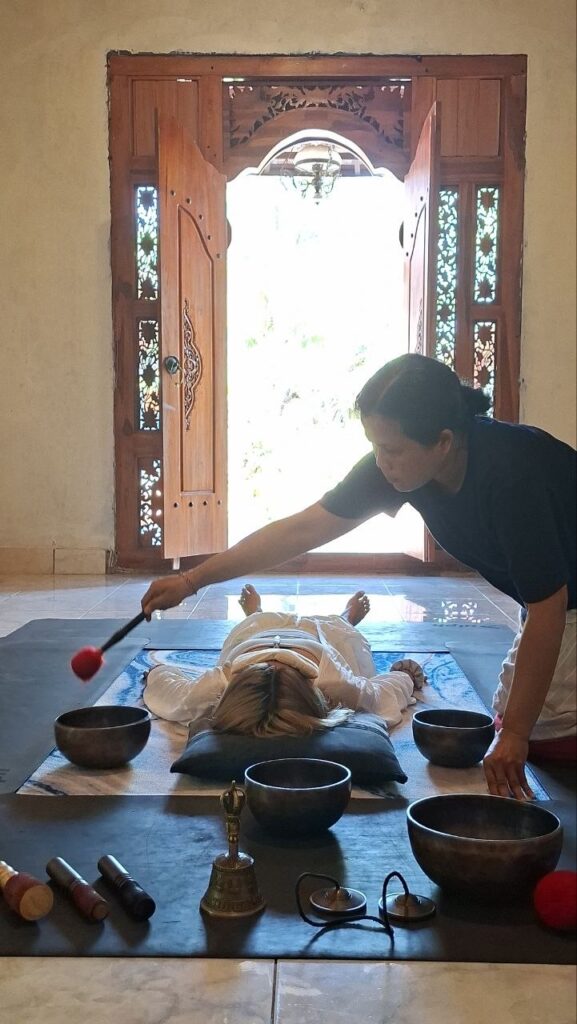
To test a Tibetan singing bowl sound properly, rest the bowl flat on your open palm and strike the upper outer rim gently with a padded mallet, or rub a wooden striker steadily around the outside edge. Pay attention to five key qualities:
- Initial strike tone
- Resonance and sustain
- Overtones and harmonic complexity
- Physical vibration
- Consistency around the rim
Ask About The Bowl’s Origin, Craftsmanship And History
Understanding the difference between Himalayan-inspired designs, contemporary artisan pieces, and mass-produced items helps set realistic expectations. Before buying, ask the seller:
- Was this bowl hand-hammered or machine-produced?
- Where was it manufactured?
- What metals or alloys were used?
- Who made or supplied it?
- Is any documented information about its origin available?
By asking clear questions and buying from transparent sellers, you can navigate the market for Tibetan Singing Bowls in Bali with confidence. Bali Yoga Center is here for all of it. Contact us today for more details.