
Sound Healing with Tibetan Singing Bowls in Bali
Close your eyes for a moment and imagine this.
You’re lying on a yoga mat, a bolster beneath your knees, a light blanket pulled over you. The room is dim and warm. A single note rises — low, rich, humming. It seems to come from everywhere at once, vibrating not just in your ears but somewhere deeper. Your shoulders drop without you deciding to let them go. Your jaw unclenches. Your breath slows.
You haven’t done anything. You’ve just listened.
That’s the experience most people describe after their first Tibetan singing bowl session in Bali. And it’s one of those things that’s genuinely difficult to explain until you feel it for yourself.
| At a Glance: Sound Healing with Tibetan Singing Bowls — Bali Yoga Center, UbudFormat: Group Sound Baths & Private Sessions | Duration: 45–90 minutes | Level: All levels, no experience requiredLocation: Ubud, Bali | Includes: Himalayan singing bowls, gongs, bells | Pairs with: Breathwork, Yoga Nidra, PranayamaCertification available: Breathwork & Sound Healing Training → |
What Are Tibetan Singing Bowls?
Tibetan singing bowls — also called Himalayan bowls — are metal bowls that produce rich, resonant tones when struck with a mallet, or when the mallet is slowly circled around the rim. The sound doesn’t just ring and stop. It layers and builds, harmonics upon harmonics, creating something that vibrates through the air and — if you’re close enough — through your body.
They’ve been used for centuries across Tibet, Nepal, and the broader Himalayan region — first in spiritual ceremonies, meditation practices, and rituals connected to pre-Buddhist Bon traditions. The history is genuinely old, and their presence in contemplative and healing practice spans thousands of years.
Traditionally, the bowls were made from a blend of metals — often described as seven metals including copper, tin, and iron — each carefully proportioned by craftspeople who understood that composition changes the sound. Different bowls produce different tones and qualities of vibration. A skilled practitioner working with multiple bowls creates something layered and complex: less like a single instrument and more like an immersive sound environment.
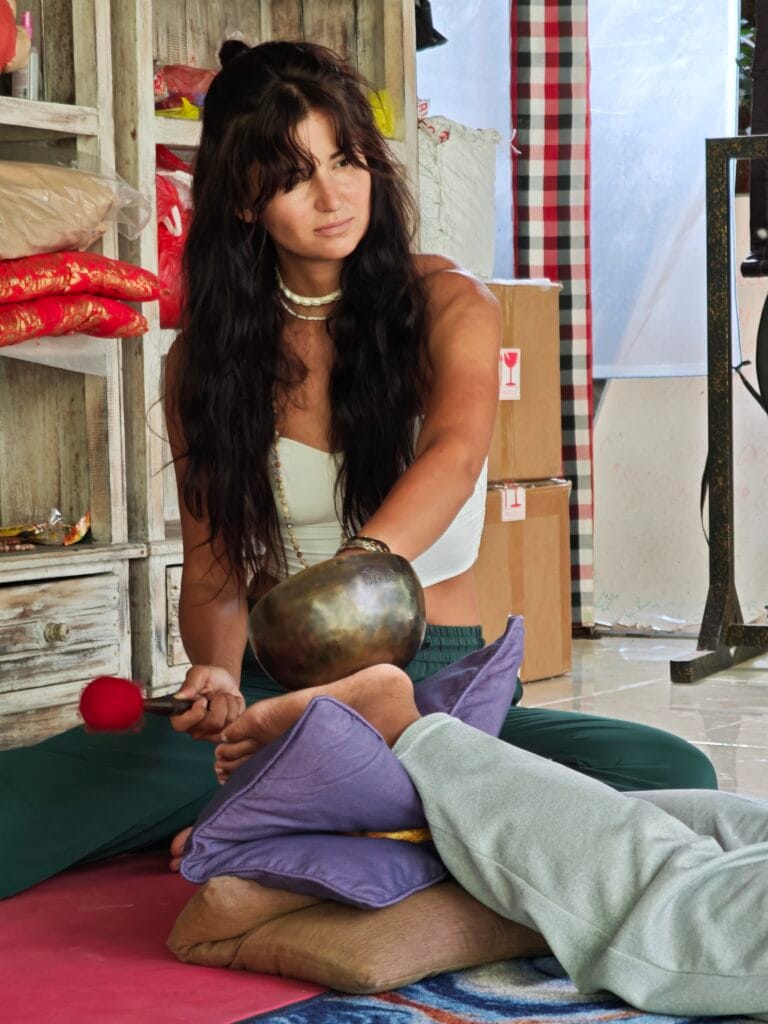
Quick Course Details
| Format | Group sound baths & private therapeutic sessions |
| Duration | 45–90 minutes per session |
| Location | Ubud, Bali — open-air jungle shala |
| Certification | Yoga Alliance YACEP — Sound Healing Training available |
| Who It’s For | Beginners to advanced — no experience required |
| Pairs With | Breathwork, Yoga Nidra, Pranayama, Meditation |
How Does Vibrational Healing Actually Work?
Let’s be clear about something upfront: the science here is still developing. There are genuine researchers studying what singing bowls do to the body and brain — and there are also a lot of overclaims online. We’ll stay on the honest side of that line.
What We Know with Confidence
• Sound affects the nervous system. When you hear calming sounds with slow, consistent vibration, your autonomic nervous system tends to shift. The stress response quietens. Published research has shown that singing bowl meditation can reduce tension and improve mood, with measurable changes in heart rate and blood pressure.
• Brainwave entrainment is real. Your brain has a documented tendency to synchronise its electrical activity with rhythmic external stimuli — called entrainment. Sustained tones from singing bowls are associated with shifts toward alpha and theta brainwave states: the relaxed, meditative, borderline-dreamy states linked to creativity and emotional processing.
• Vibration is felt in the body, not just heard. When a large bowl is struck near your body — or placed on it during a therapeutic session — you feel the vibration directly in your tissues. This is physical. Some practitioners describe it as the sound reaching places in the body that the mind hasn’t been able to consciously relax.
What We’re More Cautious About
Claims that singing bowls cure illness, unblock chakras in any medically measurable way, or serve as a replacement for medical treatment are not supported by rigorous science. They may be meaningful frameworks — and for many people they are — but it’s important to be honest about the difference between a deeply relaxing practice and a cure. Sound healing is a complement, not a substitute.
Benefits of Singing Bowl Sound Healing: A Summary
Here is what dedicated sound healing practice consistently delivers across the mental, physical, and spiritual dimensions of wellbeing:
| Category | Benefit | What It Does |
| Mental / Emotional | Stress Reduction | Activates the parasympathetic nervous system, lowers cortisol |
| Mental / Emotional | Mental Clarity | Slows mental chatter, creates spaciousness and focus |
| Mental / Emotional | Emotional Release | Gently surfaces and clears suppressed tension and old patterns |
| Physical | Improved Sleep | Shifts nervous system toward rest, reducing tension before sleep |
| Physical | Tension Relief | Vibration reaches tissues the mind cannot consciously relax |
| Physical | Breath Regulation | Slow tonal rhythm naturally deepens and slows the breath |
| Spiritual | Brainwave Entrainment | Supports alpha/theta states — meditative, creative, restorative |
| Spiritual | Deepened Presence | Anchors awareness in the body and the present moment |
What Happens During a Sound Bath in Bali?
A sound bath is the most common group format for experiencing singing bowls. Here’s what to expect.
You arrive and find your spot — a yoga mat on the floor, blankets and bolsters available. The lights dim. You settle in, lying down, eyes closed. The practitioner begins with a single bowl, letting the tone fill the room before adding others.
Over 45–90 minutes, different bowls, gongs, and bells layer and shift. Early in the session your mind may remain active — noticing things, thinking about your day. Gradually, that quietens. Many people slip into a half-sleep state: not unconscious, but deeply, unusually still. Some drift off completely.
Afterward, there’s a period of quiet to return gently. Most people walk out feeling spacious — calm in a way that feels different from ordinary tiredness. Some describe a lightness they struggle to name.
▶ Watch: Experience a sound healing session at Bali Yoga Center, Ubud →
Singing Bowls and the Breath: A Natural Partnership
One of the most interesting things that happens in a sustained singing bowl session is what it does to the breath.
Without being told to, most people find their breathing naturally slowing and deepening as the session progresses. The consistent, slow rhythm of sound seems to invite the body into the same rhythm. Breath follows sound, and the nervous system follows breath.
This is one of the reasons singing bowls and breathwork sit so naturally together. Both work with rhythm, both affect the autonomic nervous system, and both create conditions for emotional release and deeper presence — not through effort, but through allowing.
If this combination resonates with you, the Breathwork & Sound Healing Training in Bali at Bali Yoga Center explores both modalities in depth — giving you not just the experience, but the understanding to share these practices with others.
Why Bali Is a Particularly Powerful Place for Sound Healing
You could have a sound healing experience anywhere. But doing it in Bali tends to deepen it — and it’s worth understanding why.
The island’s culture has held sound as sacred for a very long time. Gamelan music — the layered bronze percussion of Balinese ceremony — has been used in temple rituals for centuries. The idea that sound carries energy, that it can shift the state of a gathering or a person, is not a wellness trend here. It’s woven into how daily life is lived.
When you participate in a singing bowl session in Ubud, you do it within a culture that already understands what you’re seeking. Offerings sit on doorsteps. Temples stand within walking distance. The environment itself becomes a container for the experience.
Add in the absence of your usual environment — the commute, the notifications, the background noise of everyday life — and something becomes available that’s harder to access at home. You’re more open. The practice lands differently.
“The word Ubud derives from the Balinese ubad — meaning medicine. The place has always been understood this way, long before wellness tourism arrived.”
Is Sound Healing Right for You?
Sound healing with Tibetan singing bowls is genuinely gentle. There’s no physical exertion, no technique to master, no way to do it wrong. You lie down and let it happen. That makes it accessible to almost anyone — people who’ve never meditated, people who find traditional seated meditation impossible, people dealing with stress or tension who simply need something that asks nothing of them except presence.
A Few Things Worth Knowing
• People with sound sensitivities, migraines, or certain hearing conditions should speak with the facilitator before a session.
• Pregnant women should let their practitioner know, as strong vibrations near the body may not be appropriate in certain stages.
• If you’re working through acute mental health challenges, sound healing can be supportive — but it’s worth discussing with a mental health professional alongside other care.
• For most people in most circumstances, the question isn’t whether it’s safe. It’s simply: are you curious?
Explore Our Related Programmes & Products
Whether you want to experience sound healing for the first time, deepen your practice, earn a certification, or take a piece of it home with you:
| Breathwork Certificate — Bali35 hrs · YACEP approved · Holotropic, Wim Hof, Classical Pranayama Learn more → | Sound Healing Training — UbudHimalayan bowls · Gongs · Yoga Alliance certified · Beginner-friendly Learn more → |
| 7-Day Yoga Retreat — UbudAll-inclusive · 2 sessions daily · Pranayama · Excursions included Learn more → | Drop-In Yoga Classes — UbudTry before you commit · All levels · Hatha, Vinyasa & Yin available Learn more → |
| Premium Singing Bowl SetsHandcrafted Himalayan bowls · Chakra tuned · Take your practice home Shop now → | Breathwork & Sound Healing RetreatCombined immersive programme · Ubud jungle setting · All levels Learn more → |
Frequently Asked Questions
Do I need any experience to try a sound bath?
None at all. This is one of the most accessible wellness practices available — there’s nothing to learn, no posture to hold, no technique to practice. You lie down, you listen, and you let whatever happens happen. Beginners often have some of the most profound experiences precisely because they arrive without expectations.
What does a sound bath actually feel like?
Most people describe a deepening sense of calm as the session progresses — like layers of tension they hadn’t noticed slowly releasing. Some feel vibrations physically in their chest, face, or hands. Some slip into a dream-like state. Some feel emotional without any clear reason. There’s a wide range, and there’s no right or wrong response.
How is a sound bath different from listening to music?
The key difference is in the physical, live quality of the vibration. Recorded music can be relaxing, but it doesn’t carry the same resonance as a bowl played live in the same room as your body. The overtones — layering of frequencies — are also distinct from most music. And the dedicated setting of a sound healing session invites a quality of stillness that casual listening usually doesn’t.
Can singing bowls help with sleep?
Many people find that a sound session — particularly in the evening — significantly improves their sleep that night. The shift into parasympathetic dominance, the slowing breath, the quietened mental chatter: all of these support sleep. It’s not a guaranteed cure for insomnia, but it’s a genuinely useful tool for anyone whose sleep is disrupted by stress or an overactive mind.
How long is a typical session?
Group sound baths usually run between 45 minutes and 90 minutes, including a short settling period at the start and a gentle close at the end. Private sessions can be longer and more tailored to specific needs or intentions.
What should I bring or wear?
Comfortable, loose clothing you’d be happy lying in for an hour or more. Socks are useful if the room is cool. Some people bring their own eye mask. Many studios provide blankets and bolsters — check in advance. Avoid large meals immediately before your session.
Can I learn to facilitate singing bowl sessions?
Yes — and Bali is a wonderful place to do it. If you feel drawn to sharing this practice, explore the Sound Healing Training in Baliand the Breathwork & Sound Healing Trainingat Bali Yoga Center — both cover history, cultural context, the mechanics of playing, and how to hold a safe and intentional space for others.
Where can I buy an authentic Tibetan singing bowl?
Bali Yoga Center offers handcrafted Premium Singing Chakra Bowl Sets— chakra-tuned, Himalayan-crafted, and a beautiful way to carry your practice home long after you’ve left the island.
Your Sound Healing Journey Starts Here
“Breath follows sound. The nervous system follows breath. And somewhere in that chain, something lets go.”
Vibrational healing with Tibetan singing bowls is not a trend. It’s an ancient practice, rooted in Himalayan tradition, now supported by an emerging body of science — and best experienced in a place that understands it at a cultural level.
Ubud, Bali is that place.
Whether you come to simply experience a sound bath for the first time, to deepen your breathwork and meditation practice, or to earn a certification that lets you share this work with others — Bali Yoga Center is here for all of it. Start with a drop-in class, explore the Sound Healing Training, or go deep with the Breathwork & Sound Healing combined retreat. Either way, the bowls are ready when you are.