
What is the Daily Schedule Like in a Bali Yoga Teacher Training? (Is it Too Intense for Beginners?)
Let’s be honest about something.
When most people search “yoga teacher training daily schedule,” what they’re really asking is: “Am I actually capable of doing this? Will I be completely out of my depth?”
It’s a quiet fear that doesn’t always make it into the inquiry form. You scroll through photos of glowing people in open-air shalas, you read phrases like “transformative 21-day immersion,” and somewhere in the back of your mind a voice says: I barely make it to a 7am class on Saturdays. What am I doing?
Here’s the thing — that voice lies.
Thousands of people do their yoga teacher training in Bali every year. Most of them are not advanced practitioners. Many of them can’t do a headstand. Some of them haven’t touched a yoga mat in months before they arrive. And the vast majority of them get through it — not just survive it, but genuinely love it.
What actually helps is knowing what to expect. So let’s walk through a real day.
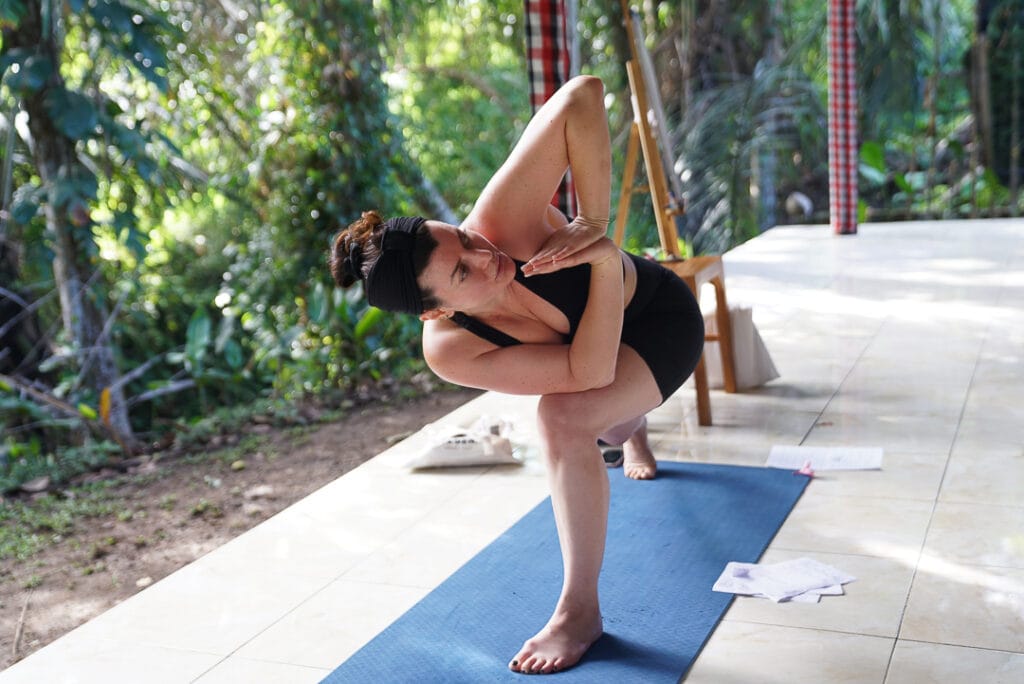
A Typical Day in a Bali Yoga Teacher Training
There’s no single universal schedule — every school has its own rhythm — but most 200-hour programs in Bali follow a similar structure. Here’s roughly how a full day tends to unfold.
Early morning (6:00–7:30am) — Pranayama and meditation
Yes, it starts early. That’s probably the one thing you can’t mentally prepare for until you’re there. But there’s something that happens when you’re sitting in an open-air shala at dawn, listening to the jungle wake up, breathing consciously — the early start stops feeling like a sacrifice and starts feeling like the best part of the day. Most students say this within a week.
This session usually covers breathwork (pranayama), meditation, and sometimes chanting or mantra. It’s gentle, intentional, and sets a tone that carries through the rest of the day.
Morning practice (7:30–9:30am) — Main asana class
This is the physical heart of the day. You’ll move through a guided practice — typically Hatha, Vinyasa, or a combination — with an experienced teacher. The class is designed for learning, not performance. Teachers will explain the why behind poses, offer modifications, and give hands-on adjustments to help you understand alignment in your own body.
You won’t be expected to nail every posture. That’s genuinely not the point at this stage.
Breakfast (9:30–10:30am)
Usually served at the school — fresh tropical fruit, rice dishes, eggs, juices. Food in Bali is one of the quiet bonuses nobody warns you about. You’ll eat well.
Morning workshop (10:30am–1:00pm) — Anatomy, philosophy, or teaching methodology
This is classroom time. You might be learning about the skeletal structure of the hip and how it varies between bodies. Or studying Patanjali’s Yoga Sutras and what they actually mean. Or working through how to sequence a class safely for beginners.
It sounds dry on paper. In practice, these sessions are often where the most interesting conversations happen. Understanding why yoga works the way it does changes how you practice it.
Lunch and rest (1:00–3:00pm)
A proper break. This isn’t thirty minutes at a desk — most programs give you two hours to eat, rest, journal, swim, or simply sit quietly. In Bali’s warmth, an afternoon nap isn’t laziness. It’s self-care.
Afternoon session (3:00–5:30pm) — Alignment lab, teaching practice, or asana workshop
This is where you start getting your feet wet as a teacher. You’ll take turns leading small sections of a class, giving verbal cues, learning how to offer adjustments, and receiving feedback.
The first time you stand at the front of a room and try to guide your classmates through a sun salutation, it feels terrifying. By week three, it feels natural. That shift is actually one of the most satisfying parts of the whole training.
Evening session (5:30–7:00pm) — Yin yoga, restorative practice, or philosophy discussion
The day winds down. Evening sessions are generally slower — yin yoga, yoga nidra, or a group discussion about the day’s philosophy content. It’s a deliberate deceleration, giving your nervous system a chance to integrate everything it’s absorbed.
Dinner and free time (7:00pm onwards)
You eat, you talk with your cohort, and you sleep. Most trainees are genuinely tired by 9pm — not in an unpleasant way, but in the deeply satisfied way that comes from having used your mind and body with purpose.
Is It Too Intense for Beginners?
This is the real question, so let’s give it a real answer.
Physically? The training is demanding, but it’s not a fitness competition. Teachers at reputable schools understand that every body is different. Modifications are offered for every posture. You are never expected to push into pain or force a pose your body isn’t ready for. People in their 50s and 60s complete these trainings regularly. People with injuries complete them. People who haven’t been to a gym in years complete them.
What does help is arriving with some basic familiarity with yoga — even just having attended a handful of classes so the names of poses aren’t completely foreign. But “beginner” doesn’t mean you’ll struggle. It means you’ll learn more.
Mentally?The volume of information can feel overwhelming at times. You’re covering anatomy, philosophy, breathwork, sequencing, teaching methodology, and more — all in three to four weeks. There are moments, usually around day eight or nine, where it all feels like too much.
Those moments pass. They’re actually part of the process.
Emotionally?This is the one people don’t always anticipate. Intensive yoga immersions have a way of bringing things to the surface — old feelings, old patterns, things you’ve been too busy to look at. It doesn’t happen to everyone, and it’s rarely dramatic. But if you find yourself crying in a yin yoga class for no obvious reason, you’re not alone, and you’re not broken. It’s a known part of the experience.
The Rhythm Changes Everything
One thing that surprises people about doing their training in Bali specifically is how much the environment helps.
At home, even the most committed student is splitting their attention. Work, relationships, the commute, the grocery list. You practice yoga in a room and then go back to your regular life.
In Bali, for the duration of your training, yoga is your life. You wake up thinking about it, you eat alongside people doing it, you go to sleep having lived it all day. That immersion creates a kind of absorption that just doesn’t happen the same way in weekend courses or evening classes spread over months.
The island helps too. There’s a gentleness to Bali — the pace, the warmth, the constant presence of something green and alive — that makes the early mornings easier and the long days feel less like work. The island’s rhythm naturally encourages stillness and self-inquiry, which is a genuine asset when you’re trying to learn something that asks you to slow down and listen.
What About Days Off?
Most programs give you one full day off per week, usually Sunday. Sundays are a full day off at most schools, which gives you time to explore — visit a temple, rent a scooter, find a waterfall, or simply do nothing at all.
Some people use rest days to study. Some people use them to sleep. Both are correct.
Breathwork: The Thread That Runs Through Everything
One element of the daily schedule that often catches people off guard is how central breathwork becomes.
Most trainings start each morning with pranayama — conscious breathing practices that range from the simple (deep three-part breathing) to the more advanced (kapalabhati, nadi shodhana, alternate nostril breathing). Over three weeks, these practices stop being “the warm-up before yoga” and start being something you actually look forward to.
There’s a reason for that. Working consciously with the breath does something to the nervous system — it shifts you out of reactivity and into a calmer, more present state. For students navigating the intensity of a full-day training, it becomes a genuine anchor.
If breathwork ends up resonating with you deeply during your training — and for many students, it does — that’s worth paying attention to. TheBreathwork Teacher Training in Baliat Bali Yoga Center is a natural next step for anyone who wants to go further into this work, whether as a personal practice or as something they want to share.
For those drawn to both breath and sound, theBreathwork and Sound Healing Training Retreat in Ubudoffers a beautiful combination — weaving conscious breathwork together with sound healing in the heart of Bali. It’s worth exploring if you find yourself moved by both during your training days.
And if you’re not ready for a full training commitment yet, thedrop-in classes in Baliare a low-pressure way to experience the teaching, the space, and the community before you decide on anything bigger.
Frequently Asked Questions
1. I’m a complete beginner. Will I be the only one?
Almost certainly not. Most cohorts are genuinely mixed in experience — some students have practiced for years, others are in their first few months. Good teachers design their classes to meet everyone where they are. You won’t be singled out, and you won’t be left behind.
2. What time does the day actually start? I’m not a morning person.
Most trainings begin between 6:00–7:00am. It’s early, and there’s no point pretending otherwise. What most people find, though, is that the morning quickly becomes their favourite part of the day. The light in Bali at dawn is genuinely something. Give it a few days.
3. How much homework is involved?
It varies by school, but most programs include some written assignments — reflective journaling, reading, and essays on yoga philosophy or anatomy. These are typically completed during free periods and rest days, not squeezed into an already-full evening. The workload is manageable.
4. What if I can’t do certain poses?
You’ll modify. Every good teacher will offer variations for every posture, and no reputable school expects advanced flexibility from a beginner training. The goal of the physical practice in a teacher training isn’t to perform — it’s to understand how poses work in different bodies so you can eventually teach them.
5. Will I actually be ready to teach after 21 days?
Yes — with appropriate expectations. You’ll have the foundations: how to sequence a class, how to cue safely, how to work with beginners, the basic anatomy of movement. Most graduates need continued practice and experience to build real confidence in front of a class, but the 200-hour training gives you the tools. What you do with them is up to you.
6. Is it worth doing even if I don’t want to become a teacher?
Absolutely. About half of the students who sign up for 200-hour yoga teacher training in Bali do so without the intention of becoming yoga teachers. Many people come for a deepened personal practice, a life reset, or simply a month dedicated to something meaningful. The credential is there if you want it — but the experience stands on its own.
7. How physically fit do I need to be going in?
You don’t need to be fit in the athletic sense. What helps is having some baseline movement in your body — walking regularly, basic flexibility, the ability to sit on the floor for periods of time. If you’ve been leading a sedentary life, a few weeks of gentle activity before you arrive will help your body ease into the early mornings more comfortably.