
Is a Bali Yoga Certificate Valid Worldwide?
You’ve been dreaming about it for months. A yoga teacher training in Bali — morning practices in open-air shalas, rice fields in the background, evenings that finally feel still. You’re ready to invest. But then a thought creeps in:
“What if I get home and nobody cares about this certificate?”
This is one of the most common questions we hear from people considering training in Bali. It’s a completely fair one. You’re spending real money, taking time off work, and building toward something meaningful. The last thing you want is to return to the UK, USA, or Australia waving a piece of paper that means nothing to any studio you walk into.
So let’s answer it clearly — no fluff, no vague reassurances.
Yes, a Bali yoga certification can be fully internationally recognized. But it depends on one specific thing: whether your school is registered with Yoga Alliance.
Here’s everything you need to understand.
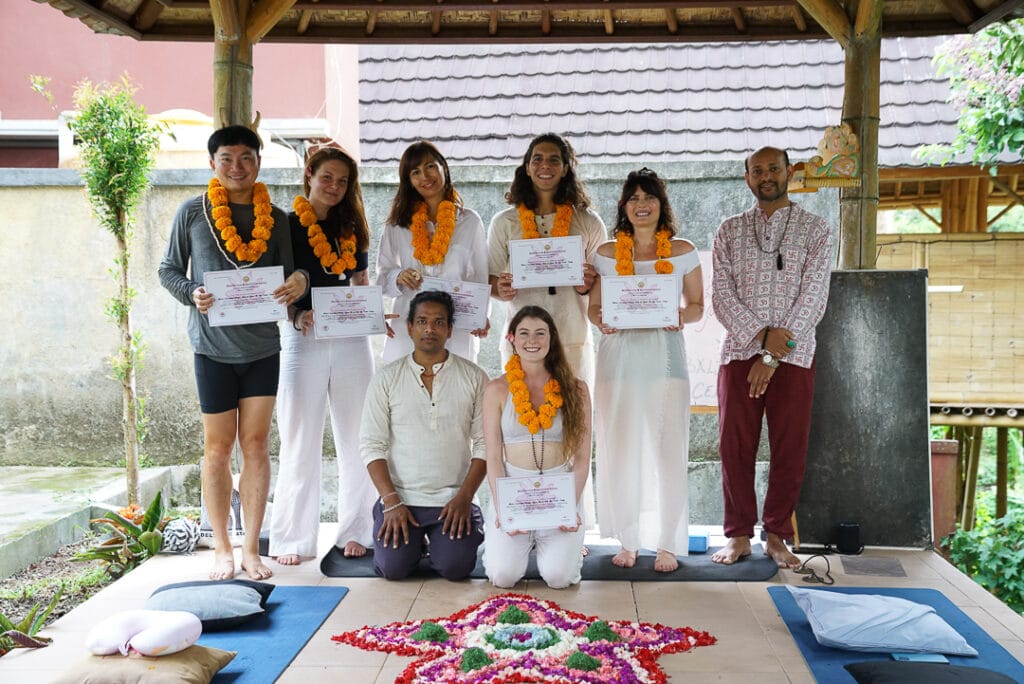
Why Yoga Alliance Is the Global Standard
Yoga teaching isn’t regulated by governments the way medicine or law is. There’s no single government body issuing licenses worldwide. So how does a studio in Chicago, London, or Melbourne decide whether to hire you?
The answer — almost universally — is Yoga Alliance.
Yoga Alliance is a US-based nonprofit that sets curriculum and ethical standards for yoga teacher training programs globally. They founded it in 1999, and it now operates as the most widely recognized credentialing body in the yoga world. When studios post job listings requiring an “RYT-200,” they’re referring to Yoga Alliance’s designation.
The reach is genuinely global. Whether you walk into a studio in Sydney, Berlin, Cape Town, or Toronto, the RYT-200 is the professional baseline most employers recognize. Furthermore, it doesn’t matter where you earned it — Bali, Rishikesh, or Brooklyn. The credential belongs to you, and it ties to the curriculum standards you completed — not the passport stamp in your travel diary.
What Does RYT-200 Actually Mean?
RYT stands for Registered Yoga Teacher. The 200 refers to the minimum training hours you need.
To earn this credential, you must:
- Complete 200 hours of training at a Yoga Alliance-registered school (called an RYS — Registered Yoga School). The curriculum must cover asana, pranayama, meditation, anatomy, yoga philosophy, teaching methodology, and supervised practice teaching.
- Register directly with Yoga Alliance after graduation. You visit yogaalliance.org, create an account, upload your certificate, and pay the registration fee. The current cost is a $50 one-time application fee plus $65 per year — around $115 total to activate your credential.
Once you register, you appear in Yoga Alliance’s public teacher directory. Any studio or employer in the world can search it instantly to verify your credentials.
The process is straightforward. The key is step one — your school must be a registered RYS. If it is, the rest follows naturally.
Is My RYT-200 From Bali the Same as One From the US or Europe?
Yes. Completely.
Yoga Alliance doesn’t distinguish between countries when it comes to credential recognition. In other words, an RYT-200 you complete in Ubud is identical — professionally speaking — to one you complete in a studio in Los Angeles or Amsterdam.
The credential lives in your Yoga Alliance profile. Employers aren’t vetting the location of your training; they’re verifying that you completed a curriculum that meets Yoga Alliance’s educational standards. Therefore, a school registered in Bali meets the same requirements as a school registered anywhere else in the world.
This is why thousands of working yoga teachers in the USA, UK, and Australia completed their 200-hour training in Bali or India — and then built genuine careers from those credentials.
How to Check If a Bali School Is Yoga Alliance Registered
This is the most important step before you enroll anywhere.
Go to yogaalliance.org and use their School Finder tool. Search by country (Indonesia) or by the school’s name. A legitimate RYS will appear in the results with a current registration status.
You can also ask the school directly: “Are you a Yoga Alliance Registered Yoga School? What is your RYS registration number?” Any reputable school will answer this clearly and without hesitation.
Watch out for vague language. Phrases like “internationally certified,” “globally accredited,” or “recognized worldwide” sound reassuring but mean nothing on their own. They’re not the same as holding an active Yoga Alliance RYS registration. Always verify independently on the Yoga Alliance website before you commit.
What Happens After Graduation
Starting to Teach
Getting your RYT-200 is the beginning, not the destination. Most yoga studios, gyms, community centers, and corporate wellness programs that require formal credentials will accept an RYT-200. Private clients don’t require certification at all — your skill and reputation carry that.
Your Yoga Alliance membership renews annually at $65. It’s not expensive, but it’s worth factoring into your planning.
Building Your Career Over Time
Over time, you can work toward the E-RYT (Experienced Registered Yoga Teacher) designation. This requires you to accumulate teaching hours after your initial certification. Moreover, E-RYT opens additional doors, like leading teacher trainings yourself.
For specialty areas like prenatal yoga, children’s yoga, or yoga therapy, additional training is typically necessary. However, for teaching general studio classes, your 200-hour certification is the right and sufficient foundation.
Why Bali Specifically — Beyond the Instagram Aesthetic
It’s worth being clear about why Bali has become a serious destination for yoga teacher training, not just a scenic one.
The teaching quality is genuinely strong. Ubud in particular has attracted experienced instructors from India, Australia, Europe, and the US over many years. The best programs offer faculty with deep lineages and real teaching experience — not just good marketing. Not ready to commit to a full training yet? A 7-day yoga retreat in Ubud is a perfect way to experience the environment, the teaching style, and the culture before you decide.
The cost difference is significant. A full RYT-200 program in Bali — including accommodation and meals — typically runs around $1,500–$3,500 USD. In comparison, a similar program in the US or UK often costs $3,000–$5,000, and you’d be commuting home each evening rather than living and breathing the practice around the clock.
That immersive quality changes things. When yoga is your entire environment for three to four weeks — not something you fit around work and life admin — the learning lands differently. As a result, there’s a depth to full-immersion training that’s hard to replicate in weekend formats.
And then there’s the cultural context. Bali is a place where spiritual practice weaves into daily life — offerings at the temple gates every morning, a reverence for the sacred that’s ambient rather than performed. For students drawn to yoga’s philosophical roots, training here adds a layer that no studio setting can manufacture.
Going Further: Breathwork and Drop-In Classes
Some people arrive in Bali for a yoga training and find themselves drawn deeper — not just into asana, but into breath-based and somatic practices that have become a significant part of modern wellness.
If that resonates with you, explore our Breathwork Teacher Training in Bali. It offers a structured pathway to facilitating your own breathwork sessions — a natural complement to a yoga teaching credential for anyone who wants to work with the nervous system and emotional release.
If you’re visiting Bali and simply want to experience a session first, our drop-in yoga classes are the easiest way to start. No commitment required — just show up.
Frequently Asked Questions
1. Will studios in the USA, UK, or Australia hire me if I trained in Bali? Yes. The hiring decision rests on your RYT-200 credential, your teaching ability, and your personality — not the country where you trained. Most studios across English-speaking countries recognize the RYT-200 as the professional standard, regardless of where you earned it.
2. What if a studio says they don’t recognize overseas certifications? This would be genuinely unusual. If it happens, it’s a policy specific to that studio — not how the industry broadly operates. A studio that won’t accept an RYT-200 from Bali-trained teachers is an outlier, not the norm.
3. Can I register with Yoga Alliance if my school isn’t registered? No. To earn an RYT-200, all 200 hours must come from a single Yoga Alliance-registered school. You can’t combine or submit hours from non-registered schools. This is why you must verify your school’s status before enrolling.
4. How long does it take to register after graduating? Once you have your completion certificate, the process moves quickly. You create a Yoga Alliance account, submit your certificate, and pay the fee. The review typically takes a few weeks. Some schools submit confirmation on your behalf to speed things up.
5. Do I legally need certification to teach yoga? No — yoga is unregulated in most countries. There’s no legal requirement to hold a certification to call yourself a yoga teacher. However, professional settings almost always ask for an RYT-200 as a baseline. Without it, the doors you can walk through are narrower.
6. What’s the difference between Yoga Alliance and World Yoga Alliance? These are two entirely separate organizations, and it’s easy to confuse them. The globally recognized RYT-200 credential comes from Yoga Alliance at yogaalliance.org. “World Yoga Alliance” is a different body. When a school mentions Yoga Alliance accreditation, ask them directly which organization they’re registered with, and then verify it yourself on the official website.
7. What other certifications exist beyond Yoga Alliance? The British Wheel of Yoga (BWY) carries respect in the UK. Australian Yoga Alliance is relevant in Australia. The International Yoga Federation has recognition in parts of Europe and Latin America. That said, for anyone training in Bali with their sights on the USA, UK, Canada, or Australia, the Yoga Alliance RYT-200 remains the most practical credential to pursue.